Blockage & Overflow vs. Sewer Backup: Why the Distinction Matters
A plumbing blockage that causes water to overflow from your fixtures is not a sewer backup. Learn the mechanical difference, why it matters for coverage, and what the courts have said.
By Leland Coontz III, Licensed Public Adjuster · July 6, 2026
California-specific: This article discusses California law, regulations, and claim practice unless noted otherwise. Rules in other states differ.
This Article Is Not Legal Advice
This article is educational commentary by a Licensed California Public Adjuster. It is not legal advice. For legal questions about your specific situation, consult a licensed California attorney.
Few coverage issues create as much confusion — for homeowners, plumbers, and even insurance adjusters — as the difference between a sewer backup and an internal plumbing blockage with overflow. The two situations look similar at first glance: water is coming up from the drains in your home. But the cause, the mechanism, and — most importantly — the insurance coverage implications are very different.
Do Not Use the Word "Backup"
Do not describe what happens when your own plumbing develops a blockage and water overflows from a low fixture in your home as a "backup." Using that word can trigger a policy exclusion that may not actually apply to your loss. The more precise — and correct — terms are blockage (or stoppage) and overflow (or fill-up).
How a Second-Floor Bathroom Drains — and What Happens When It Cannot
To understand why water comes out of the fixtures it does, you need to understand the basic layout of a second-floor bathroom's drain system. Consider this common arrangement:
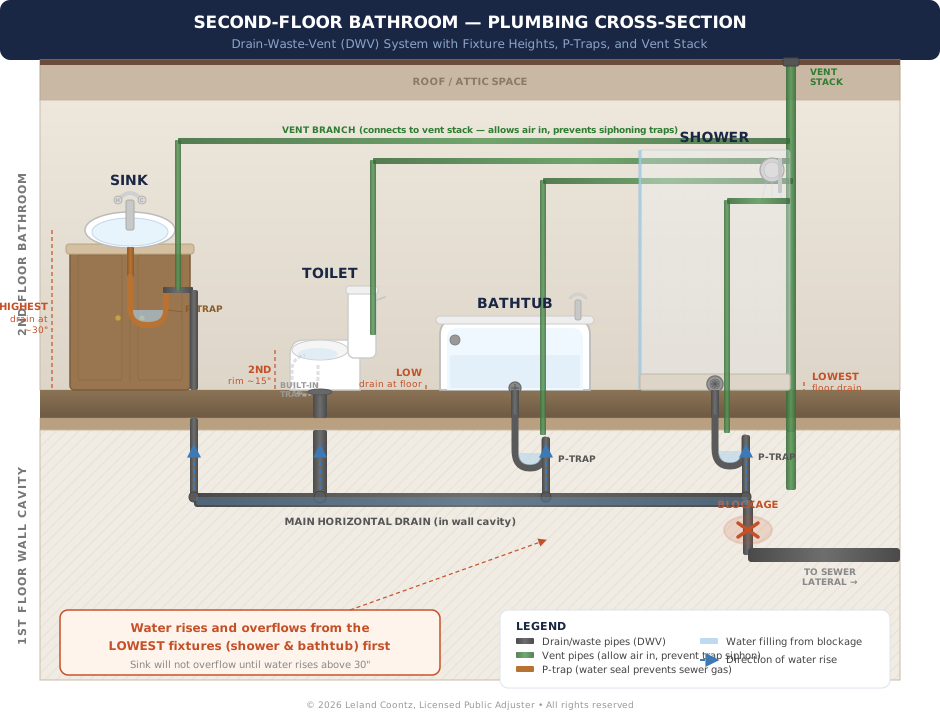
Figure 1: A detailed cross-section of a second-floor bathroom's drain-waste-vent (DWV) system. Each fixture has a P-trap (water seal) and connects to the vent stack, which allows air into the system and prevents trap siphoning. When a blockage occurs in the main drain line within the first-floor wall cavity, water rises and overflows from the lowest-connected fixtures — the shower floor drain and bathtub drain — long before it reaches the toilet bowl rim or the sink.
A typical second-floor bathroom has four fixtures connected to a common drain line: a sink, a toilet, a bathtub, and a shower. These are all at different heights:
- Sink — the highest fixture. Its drain opening sits inside a vanity, well above the floor. The P-trap is clearly visible under the sink (the U-shaped pipe that holds water to block sewer gas).
- Toilet — second highest. The bowl rim sits roughly 15 inches above the floor. The toilet has a built-in trap molded into the porcelain.
- Bathtub — low. The drain is at or very near floor level, with a P-trap located beneath the subfloor.
- Shower — the lowest. A shower pan with a floor drain sits flush with or slightly below the bathroom floor, with its P-trap beneath the subfloor.
All four fixtures connect to a shared drain line that runs down through the floor, through the wall cavity of the first floor, and eventually exits the building to a sewer lateral or septic system. Each fixture also connects to a vent stack— a vertical pipe that extends through the roof. The vent allows air into the drain system so water flows freely, and it prevents the water seals in the P-traps from being siphoned out.
What Happens When the Drain Blocks
If a blockage develops in the main drain line — say, within the walls of the first floor — the water has nowhere to go. As anyone uses any fixture in the bathroom (or even on another floor that shares the same drain stack), water begins to fill the pipe system from the blockage point upward.
Physics dictates what happens next: water seeks the lowest exit point. The water will begin overflowing from the shower floor drain and the bathtub drain long before it would ever rise high enough to spill over the toilet bowl rim, let alone reach the sink.
This Is a Blockage and Overflow — Not a Backup
The water is coming from the building's own plumbing system. Nothing is entering the property from an external sewer. The mechanism is purely internal: a clog in the pipe, water filling up behind it, and gravity pushing it out the lowest available opening.
What Is a "Backup" — and Why This Is not One
In the insurance adjusting world — at least among adjusters who understood the distinction — a sewer backup has a specific meaning: it refers to sewage from an external source(typically a municipal sewer main or a neighboring property's sewer line) being forced intothe insured's property through the sewer connection.
A true sewer backup might occur when:
- The city sewer main becomes overwhelmed during heavy rain and sewage reverses direction into homes connected to the system
- A tree root intrusion in the city's sewer line causes sewage to back up into homes on the block
- A neighboring property's septic system fails and sewage enters the insured's property through shared drainage
In all of these scenarios, the common element is that sewage or water from outside the insured's property line is being forced into the home.
Contrast that with our second-floor bathroom scenario: the blockage is in the homeowner's own pipe, inside the homeowner's own walls, on the homeowner's own property. The water overflowing from the shower drain is the same water that went down the sink or toilet moments earlier. Nothing is entering from outside. This is, mechanically, no different from plugging your kitchen sink drain and letting the faucet run — the water overflows because it cannot drain, not because something is pushing it in from outside.
The term "fill-up" is more commonly used in the South and Midwest than on the West Coast, but it accurately describes what happens: the drain system fills up behind a blockage and overflows from the lowest fixture. Whether you call it an overflow or a fill-up, it is nota backup. Homeowners, plumbers, and even some insurance adjusters sometimes use the word "backup" loosely to describe this situation, but that imprecise language can have real consequences for your insurance claim.
Why the Distinction Matters for Your Insurance Coverage
Many homeowner's insurance policies contain an exclusion for "sewer backup" or "water that backs up through sewers or drains." Some policies offer backup coverage as an optional endorsement (often with a lower sub-limit). But the standard peril insured against in an HO-3 policy is sudden and accidental direct physical loss— and a plumbing blockage that causes an overflow fits squarely within that coverage grant.
Consider this example: a family member flushes something down the second-floor toilet that should not have been flushed — a child's toy, a clump of supposedly "flushable" wipes, or an excessive amount of toilet paper. This creates a blockage in the drain line within the wall cavity. The next morning, when someone takes a shower, the water has nowhere to go and begins pouring out of the shower drain and bathtub drain onto the bathroom floor, eventually seeping through to the first-floor ceiling below.
This is a sudden, accidental occurrence. The cause is an internal plumbing blockage. The result is an overflow from the home's own plumbing system. Under a standard HO-3 policy, this type of loss is covered — it is not excluded, because it is not a sewer backup.
But if the homeowner calls the insurance company and says "my sewer backed up," or the plumber writes on the invoice "cleared sewer backup," the insurance company may seize on that language to apply the backup exclusion and deny the claim — even though no actual sewer backup occurred.
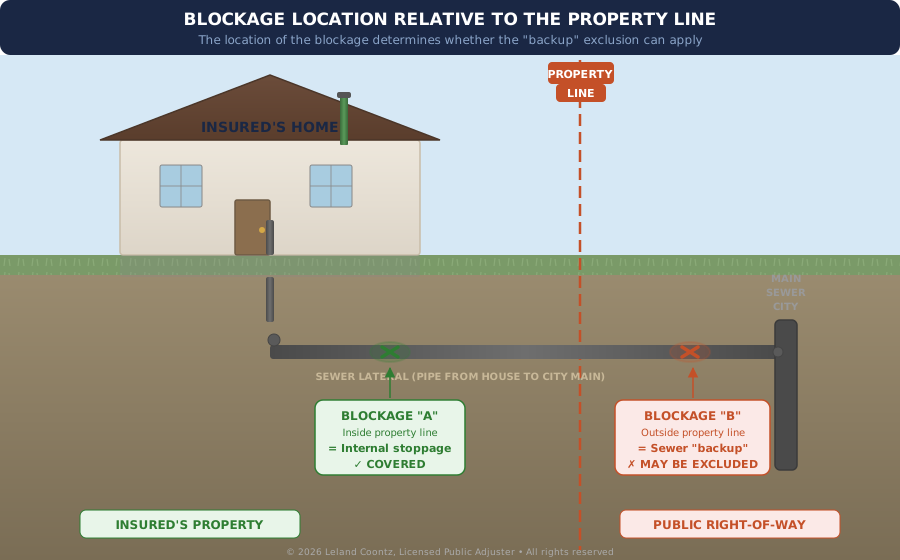
Figure 2: The same pipe, two very different coverage outcomes. Blockage "A" is inside the property line — it is an internal plumbing stoppage, and the resulting overflow is a covered loss. Blockage "B" is outside the property line in the public sewer system — if sewage is forced back into the home from this external source, the sewer backup exclusion may apply.
What a True Sewer Backup Actually Looks Like
Now that we have established what a backup is not, let us illustrate what a true sewer backup actually is — because the contrast makes the distinction unmistakable.
Imagine this scenario: A fish restaurant sits at the top of a hill. A residential home sits in the valley below. Both properties connect to the same municipal sewer line. The sewer line runs downhill, and at the junction where the home's lateral meets the main line, there is a wye fitting— a Y-shaped pipe connection that joins the home's sewer lateral to the main sewer at an angle designed to allow waste to flow downhill toward the sewage treatment plant.
Now imagine a blockage develops in the main sewer line downstreamof that wye — between the junction and the treatment plant. Sewage from the restaurant continues flowing downhill, hits the blockage, and has nowhere to go. The pipe fills up. Because the home in the valley sits at a lower elevation, physics takes over: the column of sewage in the main line exerts hydraulic pressure back up through the wye fitting and into the home's sewer lateral. It is essentially an artesian well effect— but instead of fresh groundwater, it is sewage flowing the wrong direction, forced uphill by the weight of the sewage column above it, and out through the home's lowest fixtures.
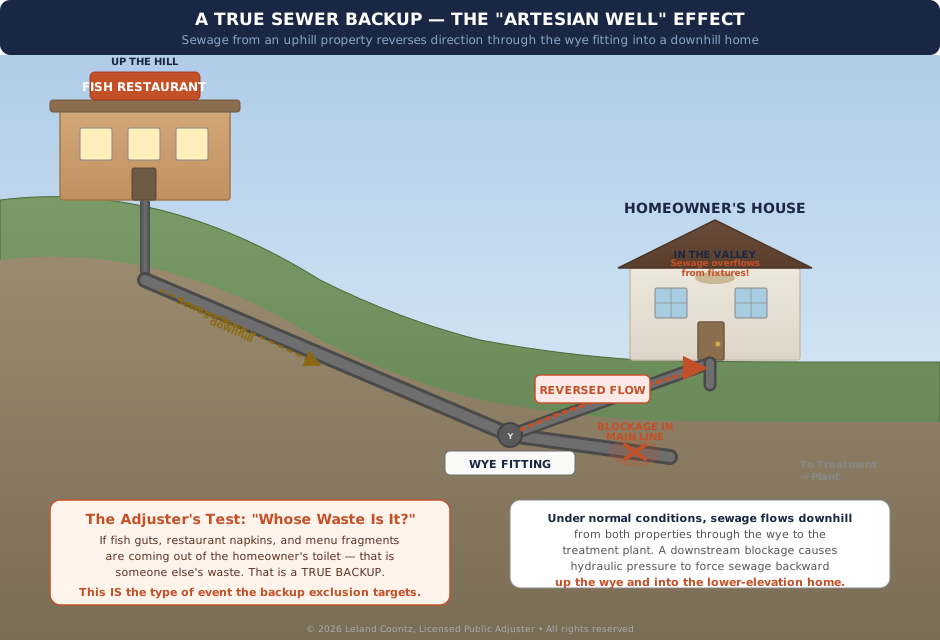
Figure 3: A true sewer backup. The restaurant at the top of the hill generates sewage that flows downhill through the municipal sewer. A blockage downstream of the wye fitting causes hydraulic pressure to force sewage backward — up through the wye and into the lower-elevation homeowner's plumbing. This is sewage from someone else's property flowing the wrong direction. This is what the "backup" exclusion was designed to address.
The Adjuster's Practical Test
Experienced adjusters have a blunt but effective way of distinguishing a true backup from an internal blockage. They ask: "Whose waste is it?"
If a homeowner finds fish guts, restaurant napkins, menu fragments, and commercial food waste coming out of their toilet or bathtub drain — waste that clearly did not originate from their household — that is unmistakable evidence of a true sewer backup. Someone else's sewage is flowing the wrong direction through the sewer system and coming up through the homeowner's fixtures.
Compare that to the internal blockage scenario: if a homeowner sees their own household waste water — maybe slightly discolored or soapy — rising up through the shower drain after the toilet is flushed, that is their own water that simply cannot drain past a blockage in their own pipes. Nobody else's waste is involved. That is a stoppage and overflow, not a backup.
What the Courts Have Said
Several court decisions across multiple jurisdictions have addressed this exact distinction. While no single case is binding everywhere, together they paint a clear picture: where the blockage is located matters, and insurers bear the burden of proving the backup exclusion applies.
Pichel v. Dryden Mutual Insurance Company (N.Y. App. Div., 3rd Dept. 2014)
This is the leading case establishing the "property-line test."The insured's apartments sustained water damage when waste water entered through toilets, bathtubs, and floor drains. The insurer denied coverage under the exclusion for "water which backs up through sewers or drains."
The court held that the policy was ambiguousbecause it did not define "sewer," "drain," "backup," or "plumbing system." The court drew a critical distinction: water damage caused by a backup/overflow that originates from a pipe or clogged drain located withinthe insured's property line comes from the insured's plumbing system and is covered by the policy; conversely, if the cause of the backup/overflow is from outsidethe insured's property boundaries — such as a clogged municipal sewer — the sewer or drain exclusion is applicable.
Critically, the insurer failed to present any evidence that the blockage occurred off the insured property, so the exclusion did not apply. This case muddied the waters somewhat — the word "backup" appears throughout the opinion even though the court ultimately concluded this was an internal plumbing event, not a true sewer backup.
Cheetham v. Southern Oak Insurance Company (Fla. 3d DCA 2013)
A pipe located on the insured's property deteriorated and collapsed, forming a blockage that caused waste water to come up through drains into the home. The insurer denied coverage under the sewer backup exclusion. The Florida court found the loss was covered, reasoning that the blockage was within the insured's own plumbing system. The court interpreted the sewer backup exclusion to apply only where the water originates from off the insured premises.
Cameron v. Scottsdale Insurance Company (11th Circuit, 2018)
The Eleventh Circuit followed Cheethamat the federal appellate level. A pipe in the insured's plumbing system collapsed due to age, causing water to overflow from a kitchen sink drain. The court held the water backup exclusion did not applybecause the loss originated from deterioration within the insured's own plumbing system.
Porter v. Oklahoma Farm Bureau Mutual Insurance Company (Okla. 2014)
The Oklahoma Supreme Court addressed a policy that both covered "accidental discharge or overflow of water from within a plumbing system" and excluded "water which backs up through sewers or drains." The court found these provisions can coexist: on-premises plumbing failures are covered under the accidental discharge provision, while the sewer backup exclusion targets off-premises sewer problems.
A Cautionary California Case: Cardio Diagnostic Imaging, Inc. v. Farmers Insurance Exchange (Cal. Ct. App. 2012)
This is the main California case to be aware of, and it cuts the other direction. A blockage in a sewer line 20–40 feet from a toilet caused water to overflow. The court read the exclusion for "water that backs up or overflows from a sewer, drain or sump" broadly and found it unambiguous.
However, this case is distinguishable in important ways: (1) it involved a commercialpolicy, not a homeowner's policy; (2) the exclusion language differed from typical HO policy wording; and (3) the court did not squarely address the on-premises vs. off-premises distinction.
California's Doctrinal Framework
Even with Cardio Diagnosticon the books, California's broader insurance law strongly favors policyholders in this type of dispute:
- Contra proferentem — Ambiguous policy provisions are construed against the insurer and in favor of coverage. (AIU Ins. Co. v. Superior Court, 51 Cal. 3d 807 (1990))
- Reasonable expectations — Courts interpret ambiguous provisions "in accord with the objectively reasonable expectations of the insured." (Bank of the West v. Superior Court, 2 Cal. 4th 1254 (1992))
- Strict construction of exclusions — Exclusionary clauses are strictly construed in the insured's favor. (Montrose Chemical Corp. v. Admiral Ins. Co., 10 Cal. 4th 645 (1995))
- Burden of proof — The insurer bears the burden of proving a policy exclusion applies. If they cannot demonstrate the blockage was in the municipal sewer line rather than the insured's own plumbing, the exclusion fails.
An Important Exception: When Flood Coverage Overrides a Backup Exclusion
There is a fascinating wrinkle in backup exclusion law that comes into play when a true sewer backup is caused by a flood event, and the property owner has separately purchased flood coverage on the same policy.
Bishops, Inc. v. Penn National Insurance Company (Pa. Super. Ct. 2009)
In the aftermath of Hurricane Ivan, a business suffered damage when the municipal sewer system was overwhelmed by floodwater, causing sewage to back up into the property. This was, by any definition, a true sewer backup from an external source.
The policy contained an anti-concurrent causation (ACC) exclusionthat excluded water damage — including sewer backup — "regardless of any other cause or event that contributes concurrently or in any sequence to the loss." Under that exclusion alone, the claim would have been denied.
However, the insured had separately purchased an endorsement that addedcoverage for sewer and drain backup for an additional premium. The endorsement explicitly stated that the base policy's water exclusion "does not apply to this Additional Coverage."
The insurer argued that even though the endorsement covered backup, the ACC clause negated it because the backup was caused by flood (an excluded peril). The Pennsylvania Superior Court rejected this argument, finding that no reasonable insured would purchase extra sewer backup coverage for an additional premium "in the expectation that its claim under that coverage would be denied because the covered cause of loss — sewer and drain backup — was itself caused by an excluded cause of loss — flood — when the two would naturally occur together."
The court called the insurer's reading of its own policy "a variant of the sleight of hand" — creating the appearance of coverage, collecting a premium for it, and then denying the claim when the covered event actually occurred. The endorsement trumped the exclusion.
The Takeaway
Even in a true sewer backup situation — one that would normally be excluded — if the backup was caused by a flood event and the policyholder purchased flood coverage on the same policy, there may be an argument that the flood endorsement overrides the backup exclusion. This is a complex coverage question that requires analysis by a qualified attorney.
A Related Exclusion Trap: The "Underground Pipe" in a Slab-on-Grade Home
While we are discussing how insurance companies misapply exclusions to plumbing losses, there is another exclusion that deserves attention — and it is currently the subject of significant litigation in California. Many homeowner's policies exclude damage from "water below the surface of the ground" or from "underground water pipes." When a pipe breaks under or within a concrete slab foundation, some insurers — most notably State Farm, in the litigation discussed below — have applied this exclusion to deny the claim. The argument is that the pipe is "underground" because it is in the dirt.
That argument is wrong, and here is why.
How Slab-on-Grade Construction Works
In slab-on-grade construction — the most common foundation type in California and throughout the Sun Belt — the builder does not simply pour concrete on the natural ground. The process involves several steps:
- The natural grade is excavated and leveled.
- Engineered fill dirt is brought in, often from another location, and compacted in layers. This fill is specified on the building plans, may be inspected by a soils engineer, and is a structural building element— not natural earth.
- Plumbing pipes are laid on top of or within this fill, following the building plans.
- The concrete slab is poured over the pipes and fill.
The result is that the pipes — and the fill dirt they sit in — are above the natural grade. If you look at a typical slab-on-grade home, the finished floor sits well above the driveway, which sits above the sidewalk, which sits above the street. The entire foundation pad is elevated on engineered fill. The pipe under the slab is not "underground" in any meaningful sense — it is within a constructed building assembly, above the natural grade of the land.
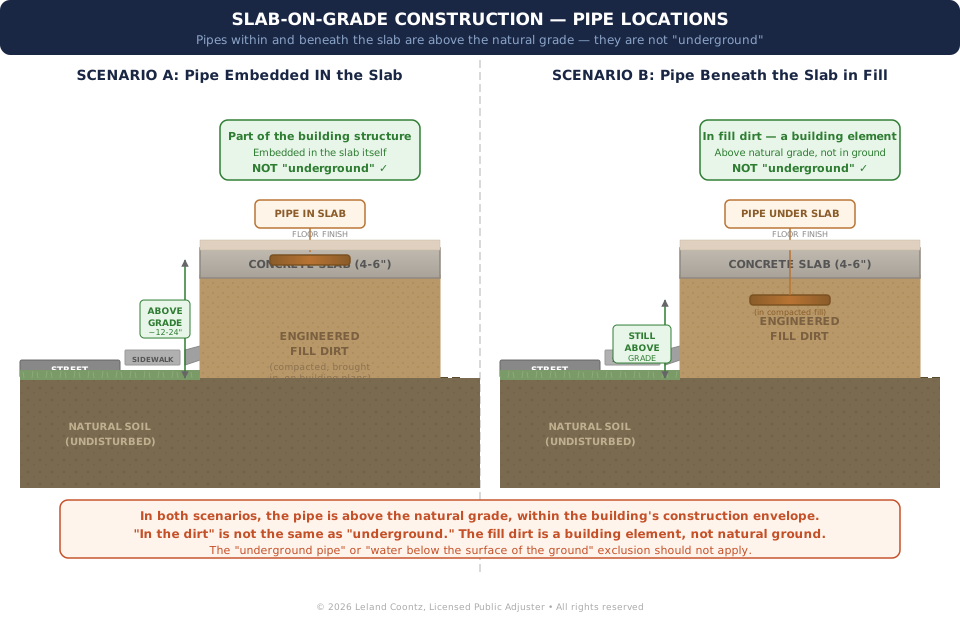
Figure 4: Slab-on-grade construction showing two common pipe locations. In Scenario A, the pipe is embedded directly within the concrete slab. In Scenario B, the pipe runs through the compacted fill dirt immediately beneath the slab. In both cases, the pipe is above the natural grade and within the building's construction assembly. The engineered fill is a structural building element — not natural "ground." Neither pipe is "underground" in any meaningful sense of the word.
Why "In the Dirt" Is Not the Same as "Underground"
The word "underground" is not defined in most homeowner's policies. Insurance companies that deny slab pipe claims argue that any pipe in soil is "underground." But that ignores the physical reality of how these homes are built:
- The pipe sits in engineered fill, not in the natural earth. This fill was brought to the site, placed according to building plans, compacted under engineering supervision, and inspected. It is a building component.
- The pipe is above the natural grade. If you were standing in the street looking at the house, the foundation pad — including the fill and the pipes within it — sits higher than the street, the sidewalk, and the surrounding natural grade. It is physically above ground level.
- The pipe is part of the building's plumbing system. It was installed during construction, appears on the building plans, and was inspected by the building department. It is no different in function from the pipe running through the wall to the second floor.
Even if some well-meaning people might use the word "underground" loosely to describe a pipe in dirt, other equally reasonable people would say a pipe above the natural grade in engineered fill is clearly notunderground. That disagreement — between two reasonable interpretations — creates at minimum an ambiguity in the policy. And under the long-established contra proferentem rule, any ambiguity in an insurance policy is resolved in favor of the insured.
Contra Proferentem
Contra proferentemis the legal principle that ambiguous contract terms are construed against the drafter. Insurance policies are contracts of adhesion — boilerplate language drafted by the insurance company with the benefit of their attorneys. The policyholder had no ability to negotiate the wording. When a reasonable person could interpret "underground" more than one way, the court must adopt the interpretation that favors coverage.
What the Courts and Industry Have Said
This is not a theoretical argument. It is actively being litigated — with significant results for policyholders:
Varela v. State Farm General Insurance Co. (E.D. Cal. 2021)
A California federal court denied State Farm's motion for summary judgment, finding that water escaping from a failed plumbing line does not qualify as "water below the surface of the ground" under the policy exclusion. The case later settled — but the ruling stands as published authority that the exclusion does not apply to domestic plumbing pipe failures under a slab.
FC&S / National Underwriter Industry Interpretation
The FC&S service — the insurance industry's own authoritative coverage interpretation resource — has consistently taken the position that "water below the ground" is meant to exclude subterranean water (natural groundwater), not water from a broken pipewithin the building's plumbing system. FC&S further notes that the exclusion was only intended to apply to domestic plumbing water when the policy contains specific language like "regardless of the source of the water" — without that language, the exclusion targets groundwater only.
Khoury v. State Farm (San Diego County Jury Verdict)
A copper water supply line beneath the slab burst. State Farm denied the claim using the "below the surface of the ground" exclusion. A California jury awarded the Khourys $1,139,500— including $500,000 in emotional distress damages for bad faith — versus State Farm's pre-trial offer of just $20,000. The verdict demonstrates that juries see through the misapplication of this exclusion.
Also note that a class of California homeowners has filed suit alleging that State Farm maintained a systematic "water protocol" for over a decade, designed to deny thousands of slab pipe failure claims using this exclusion — even after juries repeatedly found the denial to be bad faith. (Hernandez et al. v. State Farm General Insurance Co., No. 5:26-cv-01831, N.D. Cal.)
Adverse Authority
There is adverse authority on this issue. The Tenth Circuit, applying Kansas law, held in Auto-Owners Insurance Co. v. Excelsior Westbrook III, LLC(2024) that a similar water exclusion was unambiguous and barred coverage for a pipe break beneath a building. However, Kansas has significantly weaker pro-policyholder interpretive rules than California. California's strict construction of exclusions, reasonable expectations doctrine, and contra proferentem rule provide a much stronger framework for this argument. As always, the specific language of your policy controls, and you should consult an attorney experienced in property insurance coverage in your state.
At a Glance: Blockage & Overflow vs. Sewer Backup
| Internal Blockage & Overflow | True Sewer Backup | |
|---|---|---|
| Where is the blockage? | Inside the property line, in the home's own plumbing | Outside the property line, in the municipal sewer or another property's system |
| Where does the water come from? | The home's own water/waste that cannot drain | External sewage forced into the home |
| Mechanism | Water fills behind blockage, overflows lowest fixture | External pressure forces sewage in through sewer connection |
| Common policy treatment | Covered as sudden/accidental loss from plumbing system | Often excluded unless backup endorsement purchased |
| Correct terminology | Blockage, stoppage, overflow, fill-up | Sewer backup |
Practical Takeaways
- Be precise with your language.When reporting a loss to your insurance company, describe what happened mechanically: "We had a blockage in our drain pipe that caused water to overflow from the shower drain." Do not say "the sewer backed up."
- Make sure the plumber's report is accurate.Plumbers sometimes use "backup" casually. Ask them to describe the actual condition: where the blockage was found, what caused it, and how the water entered the living space. "Cleared blockage in 3-inch drain line in first-floor wall cavity" is far more useful than "cleared sewer backup."
- Read your policy's backup exclusion carefully.Not all policies use the same language. Some exclude "water that backs up through sewers or drains"; others exclude "water that backs up from a sewer or drain." The preposition matters.
- Know where the blockage is.If the plumber can confirm the blockage is within your property line — in your drain pipes, within your walls — that fact alone may defeat the backup exclusion under the weight of authority from multiple jurisdictions.
- If your claim is denied, do not accept it at face value. An insurer who denies a claim under the backup exclusion bears the burden of proving that exclusion applies. If they cannot prove the blockage was outside your property line, the denial may not hold up.
Disclaimer
This article is for educational and informational purposes only. It is not legal advice, and it should not be relied upon as legal advice. The case law discussed above is drawn from multiple jurisdictions — New York, Florida, Pennsylvania, Oklahoma, California, and others. Court decisions in one state are not binding in another. Every insurance policy is different, and the specific language of your policy controls.
For legal advice about a coverage dispute, consult with an attorney who is experienced in property insurance cases within your state.
What this article doesreflect is the traditional understanding among experienced insurance adjusters: a blockage in the insured's own plumbing that causes water to overflow from fixtures is not a "sewer backup" — it is a stoppage and overflow, and it has historically been adjusted as a covered sudden and accidental loss under standard homeowner's policies.
For more on water damage claims, see our Water Damage Insurance Claims guide. If your insurer has denied a plumbing claim using the backup exclusion, a Public Adjuster or an experienced insurance coverage attorney can evaluate the specific facts and policy language.
This article is for informational purposes only and does not constitute legal advice. Insurance policies and applicable law vary by state and by policy form. Consult with a licensed professional regarding your specific situation.
Written by Leland Coontz III, Licensed Public Adjuster, CA License #2B53445.
Get notified when we publish new guides
No spam. Only new articles and important updates for California policyholders.
Unsubscribe anytime. Your email is never shared.
Related Articles
Water Backup Endorsement: What It Covers and What It Doesn't
Many "backup" claims are actually blockages or overflows covered under your base policy — not the sub-limited backup endorsement. The distinction can save you thousands.
Accidental Discharge or Overflow
The ISO HO-3 peril that covers burst pipes, failed appliances, and overflows. The 14-day endorsement trap, tear-out coverage, and carrier denial tactics.
Frozen Pipe and Cold Weather Water Damage Claims
Coverage under standard homeowners policies, the maintenance exclusion problem, vacancy provisions, and California mountain community considerations.
Inland Marine Insurance (Not What You Think)
Despite the name, inland marine has nothing to do with water. It covers cell towers, bridges, contractor equipment, fine art floaters, and specialized property.
Have Property Damage You Need Documented?
Proper documentation is the foundation of every successful claim. A Public Adjuster can inspect the damage, prepare a professional scope of loss, and negotiate for what you are actually owed.